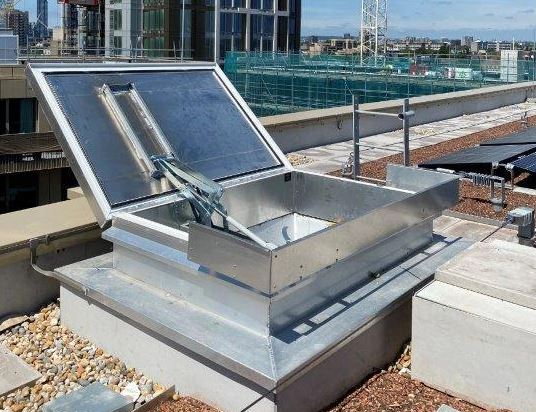
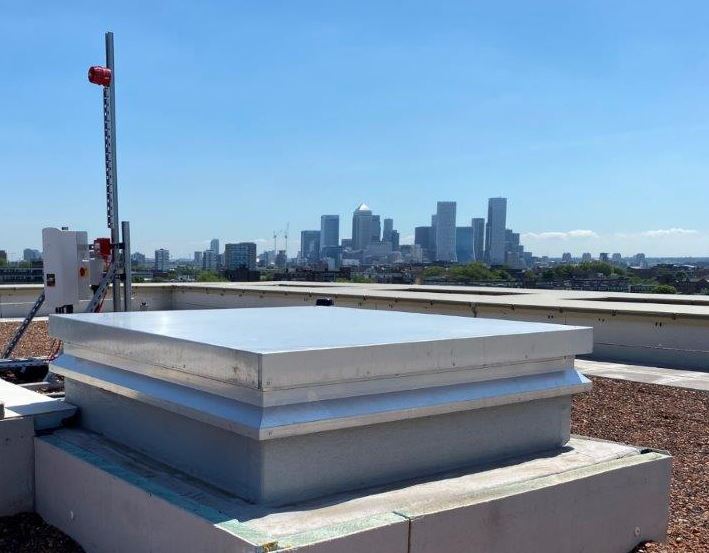
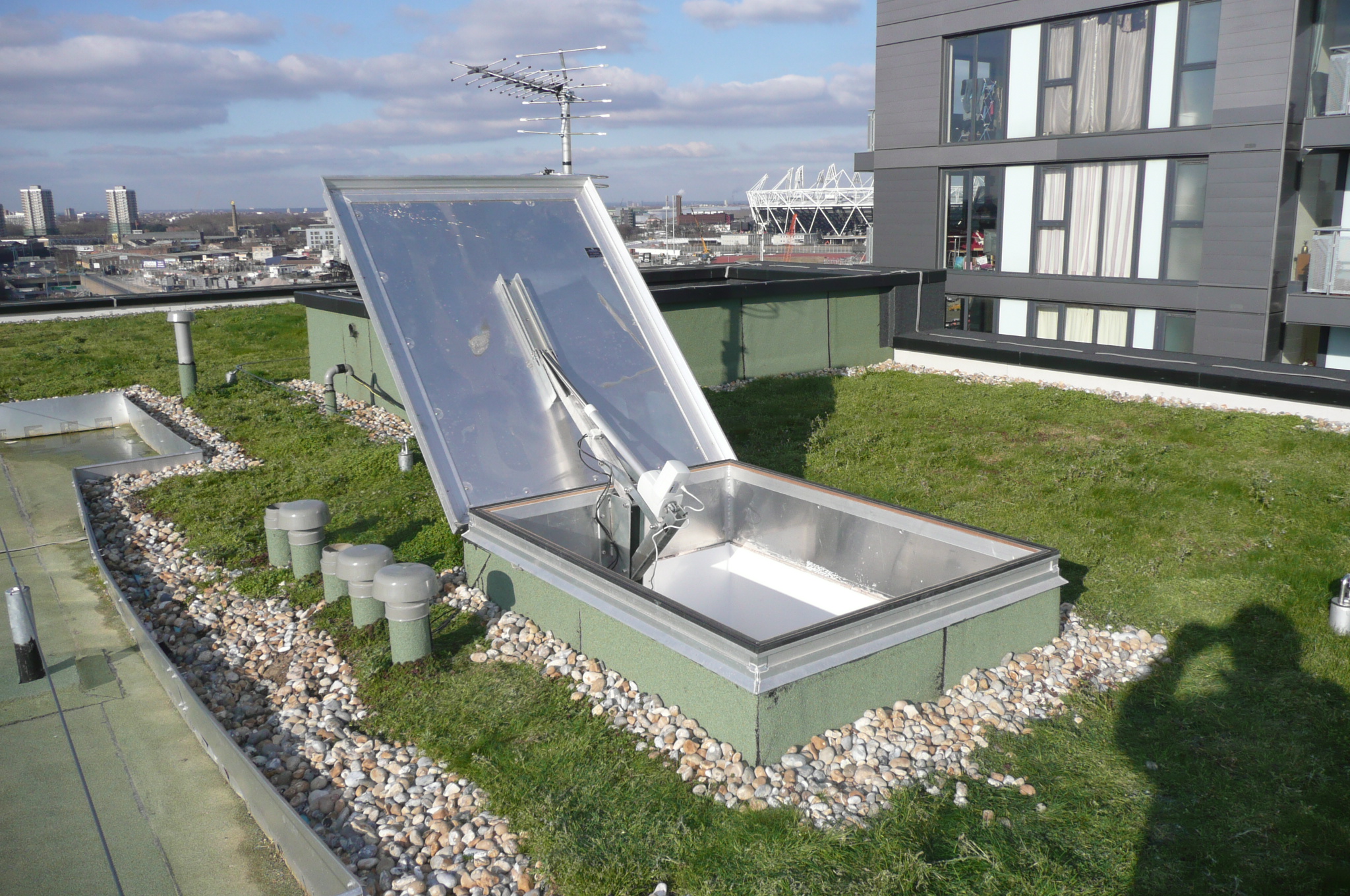
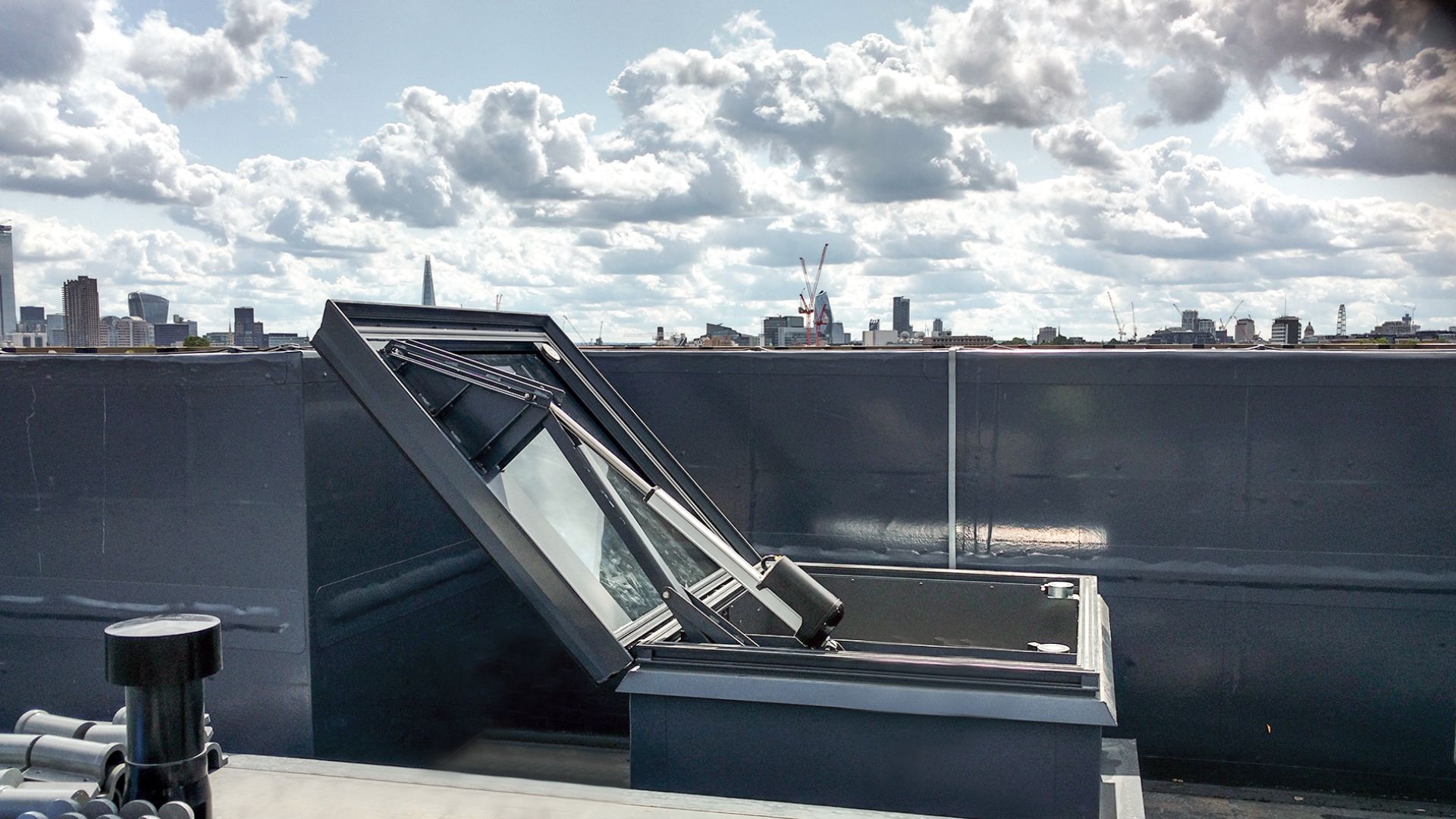
Modern smoke vent with efficient ventilation and safe roof access
SRHAOV is a sleek, insulated combination of a smoke vent and roof access hatch for flat roofs, designed to provide both effective smoke and heat exhaust ventilation and safe roof access. It is CE-marked and developed for buildings where safety, functionality, and aesthetics are essential, such as residential, commercial, and industrial properties.
With an opening angle of up to 140°, SRHAOV enables rapid and efficient extraction of smoke and hot gases in the event of a fire. The hatch can also be used for natural comfort ventilation during normal operation, while serving as a secure access point for roof inspection and maintenance. Its robust aluminium construction ensures low weight and long service life, and it can be supplied in any RAL colour to match the building’s architecture.
Model: SRHAOV
Applications: SRHAOV is designed for smoke and heat exhaust ventilation in buildings where high demands are placed on safety and aesthetics. The unit also functions as a roof access hatch, providing safe access for service, inspection, and maintenance. It is suitable for a wide range of buildings, including residential properties, offices, commercial buildings, industrial facilities, and warehouses.
Material: Aluminium
Insulation: 50 mm mineral wool (U-value 0.63 W/m²K)
Dimensions: Custom sizes available
Standard size: 1050 × 1050 mm
Minimum size: 900 × 900 mm
Maximum size: 1260 × 1260 mm
Standard upstand height: 300 mm
Operation: The hatch is operated via a control panel and manual ventilation (BVT) button
Roof pitch: Suitable for roof inclinations up to 15°
Opening angle: 140°
Control system: 24 V control panel (various options depending on hatch size)
Actuator: 24 V DC / 4A electric actuator in accordance with EN 12101-2
Components: Control panel, actuator, BVT button, smoke detector, comfort ventilation button, and push button
Technical performance (EN 12101-2):
- WL 1500 – Wind load class (1500 Pa)
- SL 500 – Snow load class (500 Pa)
- Re 1000 – Reliability (1000 cycles)
- B 300 – Temperature class (operation at 300°C)
Size (mm) | Weight | Geometric opening area Approved Document B, not EN 12101-2 | Aerodynamic opening area* (with wind deflectors) |
1050×1050 | 110 kg | 1,03m² | 0,73m² |
1260×1260 | 132 kg | 1,52m² | 1,05m² |
Any RAL colour
Safety guardrail
Magnetic contact
Glazed version
Ladder
Safety grille
Burglar resistance grille (8 mm or 16 mm)
For additional options and custom configurations, please contact us.
Complies with EN 12101-2 for smoke vents and smoke ventilation
CE marked
Approved by Byggvarubedömningen and SundaHus
Complies with Swedish building regulations (BBR)
Always read the installation instructions supplied with your order carefully before starting installation, as these may vary depending on configuration and selected options.
Refer to the separate manual for installation and connection of the control system.
Always follow the specific operation and maintenance instructions supplied with your order. These may vary depending on model, material and selected options.
Operation
- The hatch forms part of the building’s smoke ventilation system and is activated automatically via the control system.
- It can also be used for comfort ventilation within the building.
- Always ensure that the opening area is free from obstructions before activation.
Maintenance
- Functional testing should be carried out at least once per year or in accordance with applicable regulations.
- Regularly check that the hatch opens and closes correctly during testing.
- Inspect actuators, hinges and mechanical components, and keep the unit clean from dirt and corrosion.
What is a smoke vent?
A smoke vent is an openable roof hatch designed to release smoke and hot gases in the event of a fire. By quickly removing smoke, visibility inside the building improves, facilitating safe evacuation and efficient firefighting operations. In some cases, smoke vents can also function as roof access hatches.
What is a combined smoke vent and roof access hatch?
A combined smoke vent and roof access hatch is a solution that provides both smoke and heat exhaust ventilation and safe access to the roof. It allows smoke extraction during a fire while also enabling service, inspection, and maintenance of rooftop installations.
What is the difference between a smoke vent and a smoke exhaust ventilator?
The terms are often used interchangeably. The technical term in standards is smoke and heat exhaust ventilator (NSHEV – Natural Smoke and Heat Exhaust Ventilator), but “smoke vent” is more commonly used in everyday language.
What does CE marking mean for a smoke vent?
CE marking means that the product complies with EU construction product regulations and that its performance has been verified through testing and documentation. For smoke vents, this means they are tested according to relevant standards and their performance is declared by the manufacturer.
What is EN 12101-2?
EN 12101-2 is the European standard for natural smoke and heat exhaust ventilators, such as roof smoke vents. The standard specifies requirements and test methods for:
- Aerodynamic free area
- Wind and snow load resistance
- Reliability
- Performance at high temperatures
A smoke vent tested according to EN 12101-2 can be used in the design of smoke ventilation systems in buildings.
What is aerodynamic free area (Aa)?
Aerodynamic free area is the effective ventilation area provided by a smoke vent when open. This value is determined through testing in accordance with EN 12101-2 and is used by fire engineers to design smoke ventilation systems.
Can a smoke vent also be used for ventilation?
Yes. Many modern smoke vents can be used for both smoke ventilation and daily comfort ventilation, contributing to a healthier indoor environment.
Do smoke vents require maintenance?
Yes. Smoke vents are part of a building’s fire safety system and must be regularly inspected. Typically, at least one annual functional test is recommended to ensure proper operation.
How does a smoke vent open in case of fire?
Smoke vents usually open automatically via a fire alarm system or control panel. They can also be activated manually using a fire switch or control unit within the building.
Where are smoke vents installed?
Smoke vents are typically installed on the roof or at the highest point of a building, where smoke and hot gases naturally accumulate. Their placement is determined during the design phase to ensure effective smoke ventilation.